How do you begin to like Bangalore when you have moved here from elsewhere? I remember when we first came here 8 years ago, I yearned for anything that would remind me of Bombay, where I grew up – or of Chennai which was where we had lived for the 3 years before. But, nothing about Bangalore seemed like either Bombay or Chennai. I shared my woes with other friends from Bombay who had also moved here around then. One friend was living in Fraser town and another friend had moved into a quiet neighbourhood in Domlur. They missed Bombay just as much as I did.
Over the years, we have grown to like Bangalore. For me, the turning point was NERALU, the tree festival that first happened in Bangalore in 2014. I began to see how Bangalore had not only large public parks such as Lalbagh gardens & Cubbon Park but many, smaller, neighbourhood parks. More than anything else, it had people who loved trees. Here, the tree was revered more than I had seen in another city. It had people, like Asha Mokashi, who wrote about how September arrives in orange!! Bangalore had been planned in such a way that trees in the different neighbourhoods would have serial blossoming. You can read more about this at Gustav Krumbiegel & Lalbagh. I realised then that Bangalore was probably the only city in India that had a TREE STORY to tell.
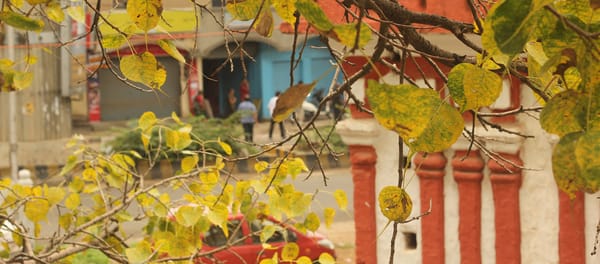
The Subramanya Swamy temple at Ulsoor along which runs the Metro line
I forgot all my yearning for Bombay and Chennai. Here was a city I wanted to know more about! I started to study the Peepul tree and the platform around it, locally known as the Ashwath katte. I started to understand more about The Ashwath katte as a neighbourhood community space. I read that one could identify the Peepul tree from quite a distance. The leaf of the Peepul made it so easy to recognise the tree. However, even before you could see the shape of its leaves, if you were going down a road and saw a tree canopy with its leaves fluttering in the wind, you could identify it as the Peepul. Naresh Keerthi had pointed out that in sanskrit, the Peepul is also called chala-dala since “its leaves are always fluttering, even at the slightest hint of a breeze”.
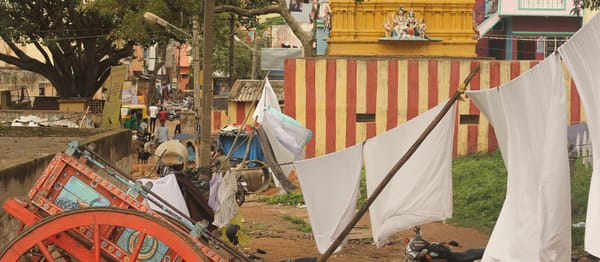
The Dhobi ghat at Ulsoor adjacent to the Ulsoor lake
Later, as I found Peepul trees, I began to discover along with them some public spaces in the city that I had not seen before, spaces that were used locally by a few people of the neighbourhood but spaces that could be public spaces for the city, because they had an aesthetic charm that was covered underneath the modern infrastructure that went past it almost destroying the space. I’m sharing here two such spaces I discovered – one, the Dhobi ghat in Ulsoor and the other, the open space that belongs to the Subramanya Swamy temple, also in Ulsoor. Both these spaces have a Peepul tree. But, these are neighbourhood spaces where the Peepul stands on one side while so much else happens. One is a livelihood space and the other is a religious space. In the Dhobi ghat open space, the Peepul tree and its shrine protect the 200 washermen from Ulsoor and other parts of the city who have used this space for several decades. In the temple space, there is a kalyani (water tank) next to the Peepul tree and families gather here often to perform religious ceremonies in the proximity of the Peepul and the kalyani. The questions that arise are: Why are these beautiful spaces so neglected today? What can we do to make them better? Whom do these spaces belong to? Who owns them?
We are just beginning to set out to find out more…will keep you posted! If anyone wants to join in, please write back! If you know anything about the history of Ulsoor or of the Dhobi ghat or Subramanya Swamy temple, please do share…some memories you have of this neighbourhood, someone you know who knows this place, anything that you think we should know, you can leave a comment here or you can reach me at kiranmkeswani@gmail.com