The Samosa Mela at Shivajinagar is a study conducted as part of a CEPT-CPP Summer school on The Everyday City that was held in June 2016 at the IIM Bangalore campus. It was a collaborative effort between CEPT University, Ahmedabad and the Center for Public Policy, IIM Bangalore. As part of the two-week workshop, the participants worked in groups to identify & analyse the everyday activities on the streets in different locations in the city. The Samosa mela project was done by Drashti Amin, (Anant Institute of Architecture, Ahmedabad), Akshata Bhandiwad (CEPT University, Ahmedabad) & Suyash Bhardwaj (NIT, Surat).
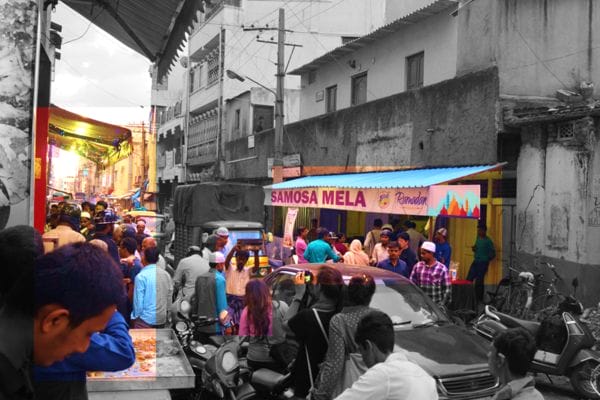
The question the project asked was: How can a savoury define the very locus of the activities occurring within a neighbourhood bringing people together during Ramzan?
The idea for this project came from a Ramzan walk led by Mansoor Ali of Benguluru by foot at the start of the workshop. The participants learnt that the ‘Samosa mela’ takes place every year during the month of Ramzan in the Shivajinagar neighbourhood. Samosas are sold in large numbers at various locations, sometimes encroaching upon footpath space and resulting in spatial negotiations between samosa vendors, pedestrians and vehicles.
The study specifically focused on the Bilal bakery that was started in 1967 on Chandni Chowk road and is the largest producer and seller of samosas here. The Bilal shop is located on both sides of the street with its operations frequently using the road space as the workers go across several times of the day. They also encroach upon an adjacent footpath where the cutting of onions is done through the day. There are smaller vendors who buy samosas from the Bilal bakery and sell in other parts of the neighbourhood either on bicycles or through setting up a stool to sell samosas.
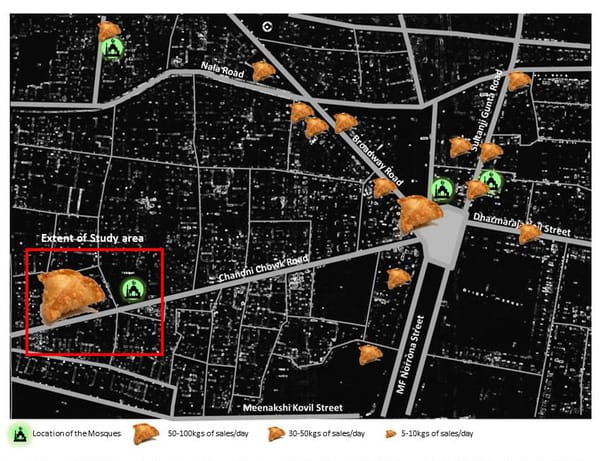
The Samosa Geography in Shivajinagar neighbourhood defining the relation between the location of the mosques and the location of the samosa vendors.
The study found that the Samosa mela has faced resistance from residents of the neighbourhood due to issues of waste disposal, parking and traffic congestion. Despite the problems, there seems to be strong support for the Mela from both residents and visitors to the area.
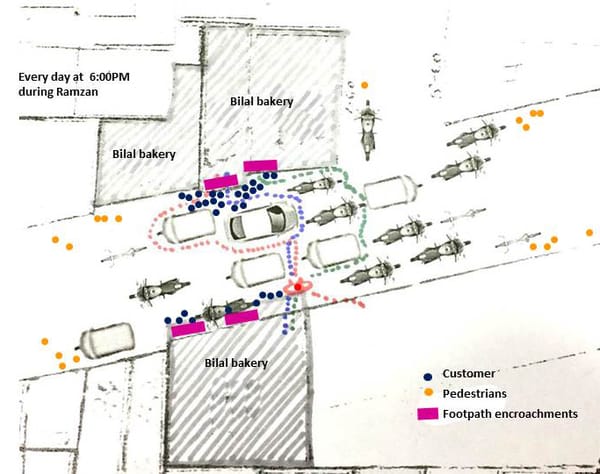
The spatial negotiations between the shop owners, customers, pedestrians, two-wheelers, auto wallahs, four wheelers and the residents of the neighbourhood.
The study concluded that there is a strange relation of illegal yet legitimate activity that is generated where the vendors, the public and the governing authorities understand the importance of the Mela and adapt themselves to the changes it brings to the neighbourhood.