Today, an urban citizen lives in a concrete jungle, with no connection to nature. No one knows where the food they eat comes from. More and more agriculture area is getting converted to residential and there is not enough land left for growing food. This has also led to a percentage of population trying to grow what they can in their surroundings, in the available space. Terrace gardens are such attempts, gaining popularity in cities.
An Organic Terrace Vegetable Garden at your home is easy to create. Fresh home-grown vegetables taste delicious, are good for health and safe from synthesized fertilisers. These are some really easy ways to incorporate an organic vegetable garden on the terrace.
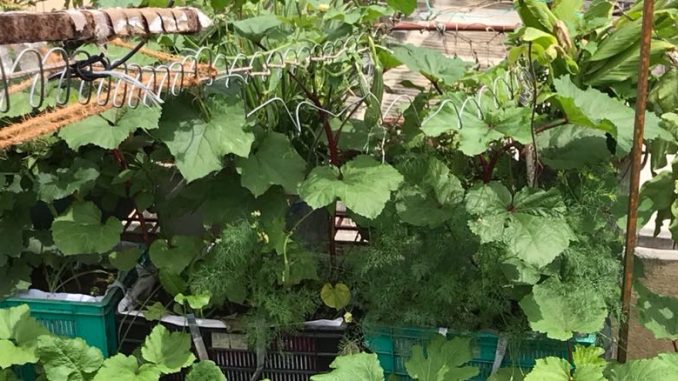
Pic: Sureshkumar
1. Sunlight requirement: The selected area for vegetable garden should receive at least 4-5 hours of good and direct sunlight.
2. Selection of area: The area selected for gardening may be land, terrace or balcony. The area should have full shade. There should be good drainage system and area must be free from insect/pest host plant.
3. Selection of containers: A container could be anything, like a pot in any shape/size. It should be able to hold water and soil and other ingredients in the container, and there should be drainage holes. Right from rice bags to thick UV-treated plastic grow bags to plastic, cement and clay pots, a container could be whatever that suits your budget. Containers made using firm materials like cement and clay and plastic or metal offer longterm stability and security to the plant. Vegetable plants can grow in anything – magic planter box, grow bags, plastic bags, plastic trays, mud pots, coir pots, plastic planters, paint buckets, drums.
4. Selection of seeds: Seed is a ripened ovule of a flowering plant containing an embryo and is capable of germinating into a new plant.
- Select disease-free seeds – avoid black spots on seeds, or white powdery substance.
- Select pest-free seeds – avoid any holes or cuts/ breakage on seeds.
- Select healthy seeds, to ensure high germination rate.
5. Sowing and transplantation: This is the simplest way to introduce new plants into the garden. Seeds can be sown directly into the garden soil or in containers where they are grown.
After sowing the seed, sprinkle a thin layer of soil. Seeds can be generally sown into the soil by maintaining a planting depth of about 2-3 times the size of the seed.
6. Irrigation (watering methods): Do not over-water and do not under-water. On an average, watering every alternate day is good enough. Monitor your plants and you will notice whether they look dried up or not. If you water the plants in excess, the water that drains out will take away the nutrients. And of course, you are wasting water too.
7. Nutrition application: Plants should be fertilized only when they are actively growing. Most plants will not need to be fertilized more than once every 1 – 3 months, between March and September. You can feed each plant with about 1/2 cup of vermicompost every two months during the growing season. Plant meal is rich in macro and micronutrients including microbes.
8. Pest management: First use a jet spray of water and get rid of all the insects from your plant. Use your fingers if needed. Usually the bottle spray is not useful here. Instead use the water hose directly. Give the plant a complete wash. Wait for 1-2 days and see if they come back. Give a second wash if necessary.
- Neem oil: Add 10 ml of Neem oil to 1 liter of water. To this, add about 5 drops of liquid handwash or 2-3 pinches of detergent. Mix it all well and give a generous spray to all the affected parts of the plant, especially the underside of the leaves. This you can do once in 10 days or so.
- Panchagavya is made out of 5 ingredients and hence its name – cow dung, cow urine, cow milk, ghee and curd. Some folks add in bananas and jaggery too. It can be used for all types of pest and diseases.
9. Harvesting & post-harvesting: All leafy vegetables can be harvested in 35-45 Days.
- Palak, Amaranthus, Coriander – cut once and pluck from roots later.
- Tomato, Starts in 2.5 months and yields for two months.
- Brinjal starts in 2.5 months and yields for 1 year, requires pruning.
- Each vegetable plant has a certain life span, after which need to be uprooted.
10. Crop rotation: Crop rotation is a systematic approach to deciding which crop to plant where in your vegetable garden from one year to the next. The goals of crop rotation are to help manage soil fertility and also to help avoid or reduce problems with soil-borne diseases and some soil-dwelling insects, such as corn root worms.
These gardens can be created on almost all kinds of buildings like residential flats, individual houses, commercial hubs, godowns and factories.
Some of the benefits to health, aesthetics and environment include:
- Reduce indoor temperature by 6- 8 degree and can reduce air conditioning cost.
- Reduce overall heat absorption of buildings and insulate the building against heat and cold.
- Convenience of safe, pesticide-free, healthy green and fresh vegetables.
- Conducive to a routine of physical exercise, clean air and being close to nature.
- Increases amount of oxygen in the air.
- Reduce sound pollution.
- Act as a habitat for city-weary birds
Note: This content was shared by Sharanya of My Dream Garden, and has been edited.