I belong to a volunteer group called Clean and Green, which has been going out on trips to the Cauvery Wildlife Sanctuary and cleaning up as much of the plastic trash as possible in the time available. On the last two occasions, Wipro has both sponsored the trip, as well as providing volunteers to help us with our task.
I thought I would post about how a cleanup usually happens….this is probably the 16th or 17th such trip we are making.
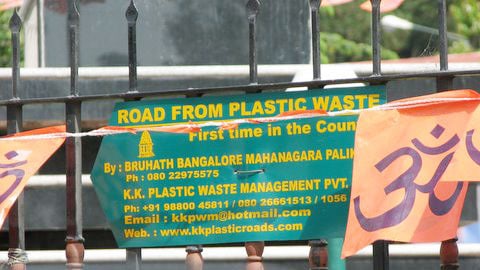
This time, the trash collected in two hours was 167 kg, and I am happy to say that the amount of trash in the picnic area is significantly less nowadays, because many of us talk to the local shopkeepers and tourists as well. The collected trash is taken by Jungle Lodges and Resorts to M/S K K Plastics, which uses it in making plastic-composite roads (the road in front of Puttana Chetty Town Hall, and Millers Road, are prime examples.) So it’s an end-to-end solution. Here’s the sign in front of Puttanna Chetty Town Hall:
At Muthathi on 22nd November 2008, we had a group of nearly 40 volunteers, who all cheerfully pitched in with a will!
Here’s the group of Wipro volunteeers, along with a few us Clean and Greeners, after finishing two hours of cleanup at Cauvery Wildlife Sanctuary, at Muthathi:

This is what usually happens….when we reach the "picnic" area, we tell the volunteers to segregate the plastic trash as they collect it, into four different sacks:
- PET bottles
- Plastic cups, glasses, and thermocole plates, cups, glasses
- Composites such as "Lays" packets (which are the least biodegradable)
- All other plastic bags and stuff.
We ask them to avoid glass bottles, because they do ultimately degrade, and also, there is a high risk of injury and infection even when volunteers use gloves.
We fan out like this:

We use rakes, and gloves, and put the trash into gunny sacks at first:

As they get filled up, they are brought to the collection point and emptied into the larger HDPE sacks:

The full sacks are then stitched up and weighed:

Many of us talk to the locals, and it does seem to be working well, because I am seeing the volume of trash in this area appreciably down now from when I went for my first cleanup. Here’s Roopa talking to some of the Forest Department officials, too.

These officials always open up their campus free for our volunteers to rest and have their packed lunch after the clean up:

After lunch, volunteers can either rest and come along in the bus to the JLR property at Bheemeshwari, or walk along the pretty, wooded 4 km road, with the Kaveri on their left, enjoying the greenery and the views:

(That sign says, "Halagooru, 19km"…Bheemeshwari is just 4 km away!)
Right outside Bheemeshwari JLR is this honoured-in-the-breach concrete signpost:

We usually head back after the cleanup, stopping for a hot cup of chai or coffee along the way. This time, roadworks along Kanakapura Road and the resultant diversaions delayed us by several hours, but the volunteers took it all in their stride, and we are immensely thankful to them! ⊕