It’s a very unusual development in the annals of democracy in India – for the first time, a deliberate political action group, with a specific agenda to be pursued through its activities, is being formed — the Bangalore Political Action Committee
PACs are nothing new around the world. In the US alone, there are thousands of PACs, each committed to its agenda. In India so far, we’ve had industry associations, which are in some ways PACs, but apart from this there aren’t very many. The usual organising themes for PACs – labour, environment, health, education, etc. – have not year coalesced into interest groups of their own, but are folded into party apparatuses. Thus, we have a women’s wing of each party, a labour wing of most parties, etc, rather than genuinely independent issue-focused PACs that engage with all parties.
insert the right 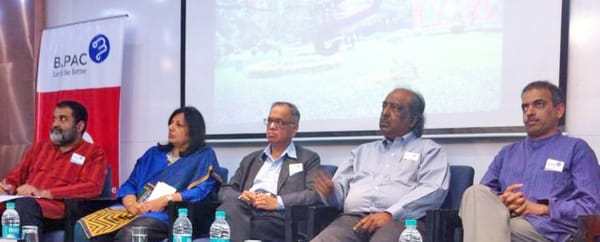
Launch of BPAC: Mohandas Pai, Kiran Mazumdar Shaw, N R NArayana Murthy, K Jairaj and Ashwin Mahesh. Pic courtesy: BPAC
There is bound to be some scepticism about whether BPAC will be impactful. But, as I see it, by its very existence BPAC is achieving something – spreading the idea that it is alright (and even necessary) for those who care about something – in this case, our city – to get together and become champions of change to achieve very specific goals, THROUGH POLITICS AND GOVERNANCE.
That last part is the most important thing. There have always been those who wanted change, and worked for it in NGOs and advocacy groups. There are also those who seek this change at the ballot box, by contesting elections. What PACs can do, for the first time in India, is to provide a layer of strength and support to those ongoing efforts. That changes the game.
What can you do to help? Two things. Study the agenda of BPAC and if you agree, become a supporter in some way – find good candidates, join election campaigns, support advocacy, help in voter registration, and much more. Second, on election day, make sure that everyone you know who agrees with the agenda shows up at the ballot booth, and votes for the change you want to see.
At the Bangalore Political Action Committee’s launch yesterday, we (members — Kiran Majumdar, Mohandas Pai, K Jairaj and I) said quite predictable things about BPAC, since we’re speaking from the inside, about what BPAC proposes to do. These details are on the BPAC web site too. What I found more interesting is what NRN said.
He said that leadership in politics should set goals that resonate across the party. To his mind, he said, only two things are needed. We should work to make India’s private sector the most competitive in the world, and make India’s public sector the most fair, transparent, and accountable in the world. If the goals are lofty and clear like that, we can go on measuring ourselves against them, and that will provide motivation for all the things we need to do. And millions of people can understand these goals quite easily.
I felt there was a lot of goodwill for BPAC, even from the media. It’s natural that our invitees should wish us well, but when others are optimistic about what we’re attempting, then that’s a good sign. Many cameramen and reporters came to say ‘good luck, Sir’, and ‘I hope this succeeds, Sir. Bangalore needs more people to participate’. That is the key, as I always say. We must increase the number of people working to solve problems. And the rest will take care of itself.⊕