If you are craving for a good scrumptious meal yet with less spices, Bengali cuisine is the right thing to try. The food, originating from West Bengal, predominantly has fish, vegetables and lentils, and is mostly served with rice, Luchi or pooris or parathas. Generally mustard oil is used for preparation, and sometimes, even sunflower oil. The key spices that bring a different flavor are cumin, fennel, fenugreek, kalonji and black mustard seeds, usually referred to as Phoron. This mixture of spices is generally used for preparation of vegetables and fish.

Maach curry. Pic: Wikimedia commons
A large number of Bengalis have fish at least once in a day. For starters, fish cutlet is worth trying out. This cutlet is prepared with boiled and minced fish and mashed boiled potatoes, then deep fried and topped with bread crumbs. For the main course, one of the most loved dish is Ilish Maach (Hilsa fish), a gravy prepared with mustard seeds paste and usually served with rice. This dish is a little tangy in flavour. Mutton gravy is another must try, it is usually served with Luchi. Mutton/lamb is cooked in moderate amount of spices and has a semi thick gravy.

Fish curry. Pic: Wikimedia commons
Vegetarian food lovers, don’t need to worry, there are ample choices for you in this cuisine. The regular vegetable curry prepared with phoron and lentils, and served with rice, makes for a healthy diet. In almost all the Bengali restaurants in Bangalore, one would find a vegetarian thali comprising one vegetable curry, lentils and rice. Aloo poshto (Potato cooked with poppy seeds paste), is the most loved dish among vegetarians, generally served with rice or Luchi. The main component of the dish is the poppy seeds paste, usually makes for a semi thick gravy. Another dish called Shukto, prepared with mixed vegetables, has an emphasis on the bitterness. Usually, the vegetables used are bitter gourd, ridge gourd, brinjals, raw bananas and radish. The bitterness of the vegetable is kept intact while preparing this dish.
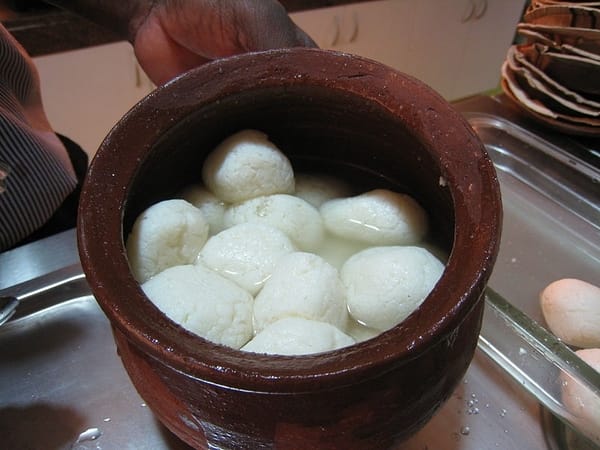
Rasagulla pot. Pic: Wikimedia commons
Desserts form the key part. Mishti Doi (sweetened curd) and Roshogulla or rasagulla made of homemade cottage cheese or paneer balls dipped in sugar syrup, make for a happy ending to your meal.
Bengaluru has a plethora of Bengali restaurants for you to try out.
The Esplanade: 151, KHB Colony, 1st Floor, 60 Feet Road, 5th Block, Koramangala. Ph: 40927888, 40927878
Cost of two is Rs 600 without alcohol. Alcohol available here.
Zomato has rated it 3.5 out of 5.
Bhojohori Manna:
668/B, 6th Block, Koramangala. Ph: 25503666, 9533803666, 9620903666
AND
42, 7th Cross, Opposite RV Dental College, 1st phase, JP Nagar. Ph: 26593666, 9916972666
Cost of two is Rs 500 without alcohol. Alcohol not available here.
Bangaliana: 355, 1st ‘B’ Main, 7th Block, Opposite HDFC Bank, Koramangala. Ph: 25711058,
26482529Cost of two is Rs 300 without alcohol. Alcohol not available here.
Howrah Bridge: 4th Floor, Bangalore Central Mall, 9th Block, Jayanagar. Ph: 9980577745
Zomato has rated it 3.3 out of 5.
Cost of two is Rs 400 without alcohol. Alcohol not available here.⊕